

EXECUTIVE SUMMARY
AI is elevating—not diminishing—the importance of front-line managers. Research from McKinsey, Gartner, Gallup, and Accenture points to the same conclusion: the organizations most likely to realize value from AI are the ones that equip managers to interpret AI-generated insights, coach teams through change, and integrate new tools into daily work.
The Case for Reframing The Manager Role
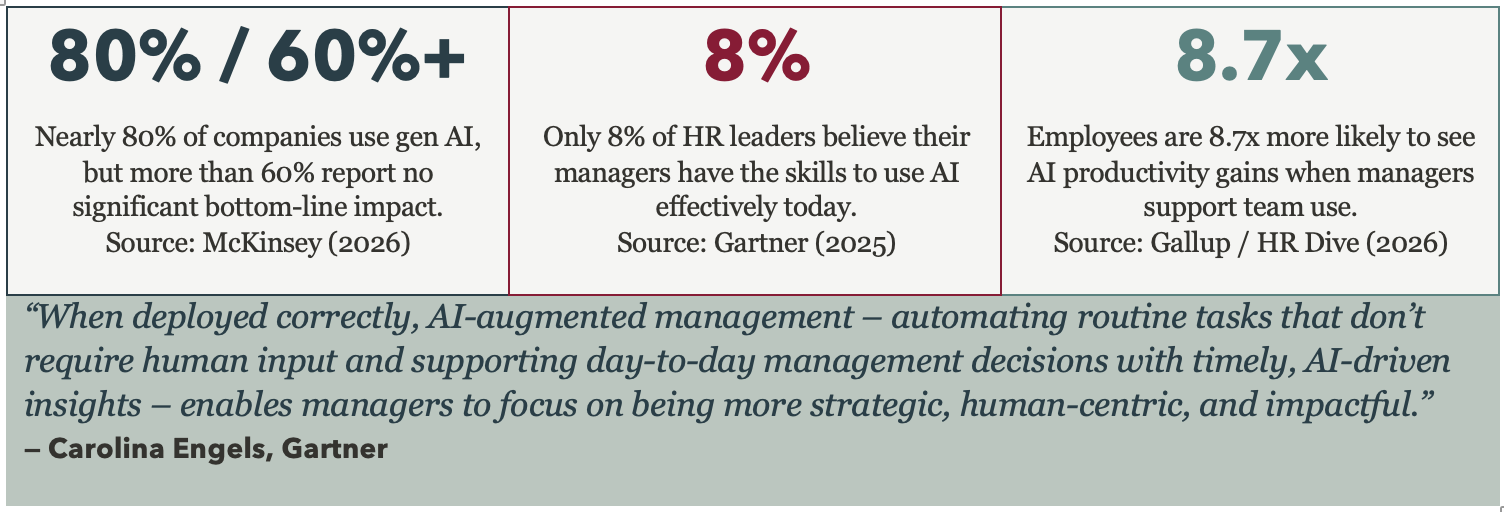
The shift to AI-enabled work is not simply a technology rollout. It is a management transformation. McKinsey notes that although almost 80 percent of companies are using generative AI, more than 60 percent report no significant bottom-line impact, and it identifies one critical reason: too few workers have the capabilities needed to collaborate effectively with AI. For front-line environments—where managers shape schedules, daily priorities, problem solving, and coaching—this capability gap becomes especially consequential.
Gartner reaches a similar conclusion from the management side. Its research found that only 8 percent of HR leaders believe their managers have the skills needed to use AI effectively today. At the same time, one in three HR leaders say their organizations already expect higher performance from employees when they use AI. In other words, expectations are outpacing managerial readiness.
Gallup’s workplace research adds the behavioral dimension. Employees who believe their manager supports their team’s use of AI are 8.7 times more likely to strongly agree that AI has transformed how much work gets done in their business, and 7.4 times as likely to say AI gives them more opportunities to do what they do best every day. Combined, these findings position the front-line manager as the multiplier—or bottleneck—of AI value.
How AI Is Changing The Role of the Front Line Manager
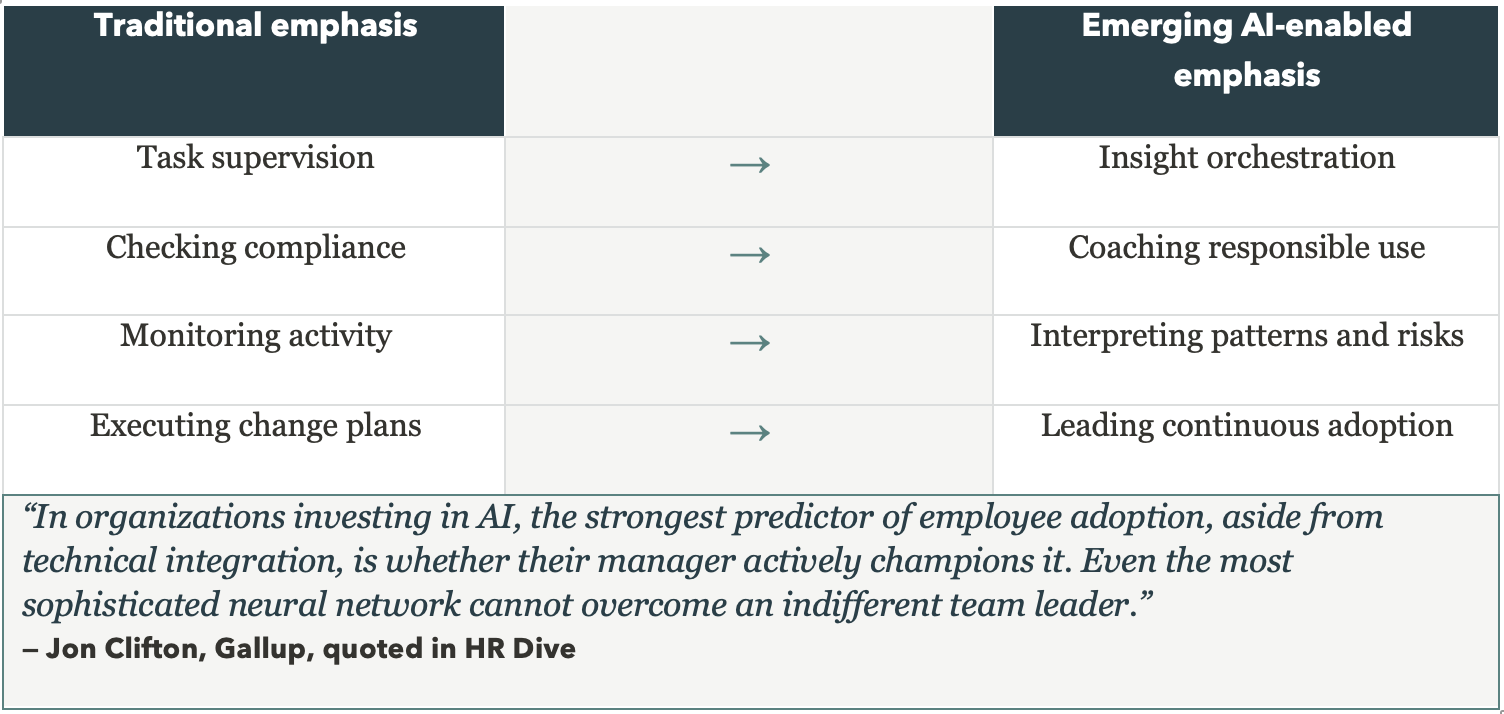
AI changes the manager’s role in four visible ways. First, it reduces the amount of time managers must spend gathering, consolidating, and interpreting information by surfacing real-time insights more quickly. Gartner describes this as a shift from “managing information and decisions” to “coordinating insights and predicting the needs of employees.” Second, the role becomes more coaching-intensive: managers must help people interpret AI outputs, adopt new workflows, and apply judgment when technology recommendations conflict with reality. Third, managers become the bridge between policy and practice—turning governance into everyday behaviors. And fourth, they become change leaders, responsible for building trust, setting norms, and demonstrating responsible use by example.
The New Capability Profile for Frontline Managers
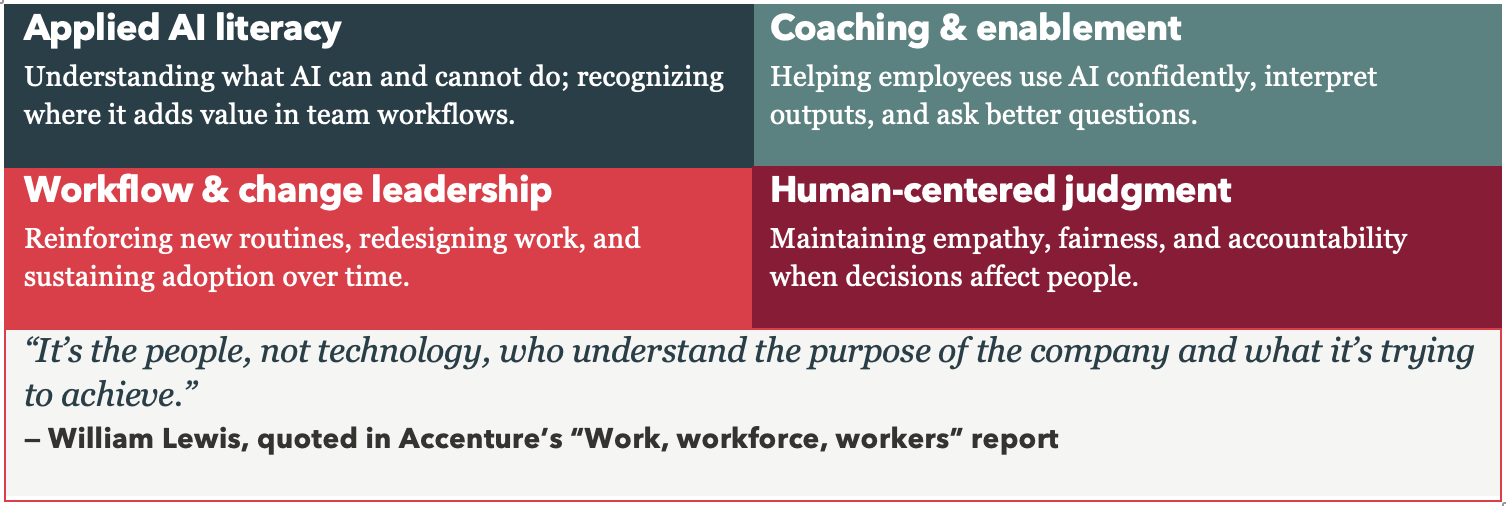
The research suggests that front-line managers now need a blended capability profile that combines digital fluency and human leadership. McKinsey emphasizes the need to build “human capital first,” noting that meaningful ROI requires more serious investment in workforce capabilities before ambitious AI efforts are implemented. Gartner reinforces this with practical recommendations: role-specific AI learning, clear guardrails, human-centric leadership, and the co-design of evolving roles. Accenture adds a broader leadership requirement: organizations must “lead and learn in new ways” so managers can support more meaningful work while preserving trust.
For front-line managers, four capability areas stand out as most important: applied AI literacy, coaching and enablement, workflow redesign and change leadership, and human-centered judgment. These are the skills that help managers move from passive receivers of technology to active leaders of adoption.
How Organizations Can Help Managers Adapt Positively
The strongest implications for organizations are practical.
- Reframe how AI is thought of within your organization. Rather than AI being a tool or having “Humans In-The-Loop” with AI as a driver and people as the “governor”, consider AI as the companion, the enabler to greater abilities for managers and teams. This reframing becomes “AI In-The-Loop” with your people as the drivers, thus making the use of AI less about the technology and frankly, less intimidating.
- Invest in managers by providing role-based, hands-on AI training rather than generic awareness modules. Gartner reports that only 14 percent of organizations provide support to managers on how to integrate generative AI into daily tasks, leaving a major enablement gap. Then reinforce training by continuously investing in developing both technical and human-centric skills and not making AI training a one-time event.
- Redesign workflows—not just tasks. Accenture argues that AI’s full value comes when organizations rethink processes across the value chain rather than simply bolting AI onto current work. Fourth, make guardrails explicit. Gartner recommends setting ethical use rules, data boundaries, and approval processes before scaling.
- Support manager-led adoption. Gallup’s research makes clear that managers influence whether employees see AI as useful, trustworthy, and worth using.

Bottom Line for Leaders
AI is not replacing the front-line manager. It is upgrading the role. The manager becomes the connector between technology and trust, insights and action, productivity and employee experience. Organizations that want AI to improve performance at scale should invest in manager capability with the same seriousness they invest in technology.
People Results perspective: for many organizations, the fastest route to measurable AI value is not another pilot. It is enabling front-line managers to lead with confidence, coach with clarity, and operationalize AI in ways that strengthen—not strain—the team experience.
KEY TAKEAWAYS
• AI value at the front line depends on manager capability, not just tool availability.
• Front-line managers need new skills in AI literacy, coaching, workflow redesign, and judgment.
• Organizations should train managers practically, redesign work intentionally, and set explicit guardrails.
• When managers actively champion AI, employees are far more likely to adopt it and see positive impact.
—Written by Jason Clark, Lead Research Consultant
SOURCES:
- McKinsey & Company (January 15, 2026). A US productivity unlock: Investing in frontline workers’ AI skills.
- Gartner (October 8, 2025). Gartner Research Finds Only 8% of HR Leaders Believe Their Managers Have the Skills to Effectively Use AI.
- HR Dive / Gallup (April 9, 2026). Manager engagement is slipping — and affecting AI use, Gallup finds.
- Accenture (January 16, 2024). Work, workforce, workers: Reinvented in the age of generative AI.